
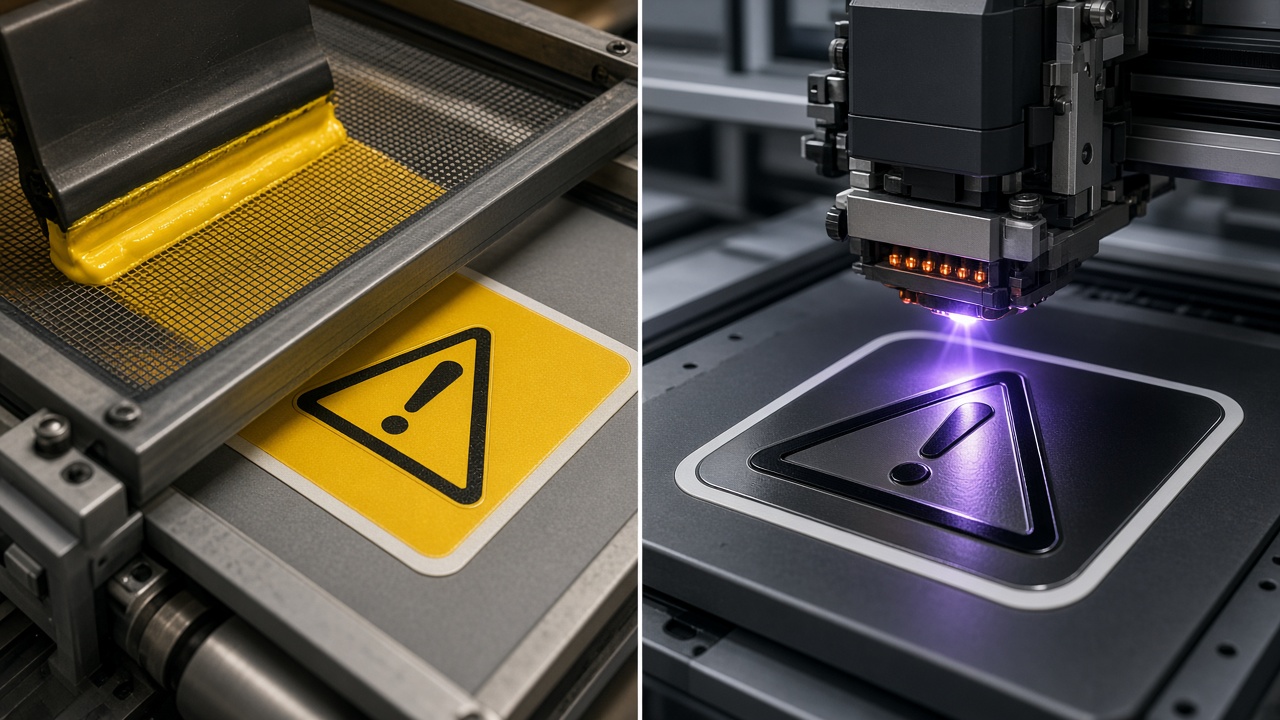
Digital printing is fast, flexible and excellent for many jobs. Warning and dangerous goods labels are different: the marking must stay clearly readable for years under harsh conditions. That is where classic screen printing shines — a technique that can look old-fashioned at first glance, yet remains the benchmark in safety marking.
How the two processes work
Screen printing: For each colour, a fine-mesh screen is exposed with a stencil. A squeegee forces the ink through the open areas onto the film. Every colour — signal red, orange, black — is mixed exactly and printed one after another.
UV digital printing: An inkjet printer places tiny droplets of a few base colours (usually CMYK, optionally white) onto the material; UV light cures the ink instantly. Colours are created by screening and mixing in the print image.
The advantages of screen printing in detail
1. Significantly thicker ink layer
Depending on the mesh, screen printing lays down many times more ink — typically several times the film thickness of a digital print. More pigment means better opacity, richer colours and more reserve against abrasion. A hazard label that scrapes along a pallet does not lose its colour as quickly when screen-printed.
2. Superior light and weather resistance
Red, orange and yellow — the key signal colours — tend to fade in sunlight. Screen-printing inks can be formulated with highly lightfast pigments at high concentration. Result: a screen-printed label often stays colour-true outdoors for many years, while digitally printed labels without a protective laminate can fade noticeably faster.
3. Exact spot colours instead of CMYK approximation
Standards specify colours within tight tolerances. In screen printing each colour is mixed and printed as a solid spot colour — no screening, no colour shift between runs. UV digital printing must build hues from process colours, which reaches its limits especially with vivid orange and signal red.
4. Chemical and solvent resistance
On drums, cans and tankers, labels meet oils, fuels, cleaners and acids. Solvent-based screen inks bond tightly with the film surface and are therefore particularly durable.
5. Sharp edges and solid fills
Symbols, digits and border lines are printed as closed solids — crisp and even, without halftone dots. That improves readability at a distance, which is critical for placards on vehicles.
6. Cost-effective in volume
Once the screens are made, unit costs fall sharply with every run. You benefit directly through our Volume pricing: the more labels you order, the lower the price per piece.
Direct comparison
| Criterion | Screen printing | UV digital printing |
|---|---|---|
| Ink layer thickness | hoch | gering |
| Lightfastness of signal colours | very high | medium, often needs a laminate |
| Colour fidelity to standard | exact solid spot colours | CMYK approximation |
| Chemical resistance | very good | limited |
| Very short runs / single pieces | less economical | ideal |
| Unit price at high volumes | niedrig | unchanged |
When is UV printing still the better choice?
For single pieces, variable data (e.g. sequential numbers) or photographic artwork, digital printing is the right choice. For standardised safety marking that must last and look compliant, screen printing remains first choice — which is why we produce our warning and dangerous goods labels in Hamburg consistently with this process.